About BCFV4
BCFV4 is an empirical software tool for assessing expected fragmentation in block cave mining operations
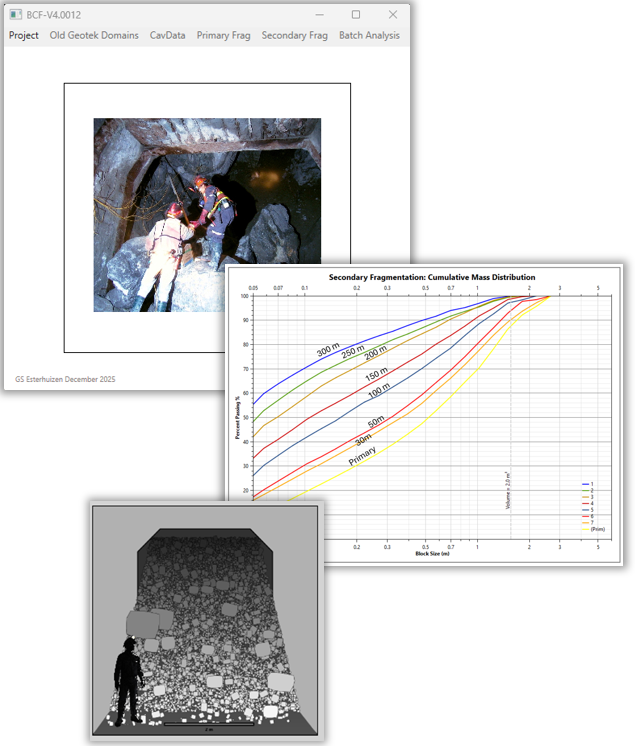
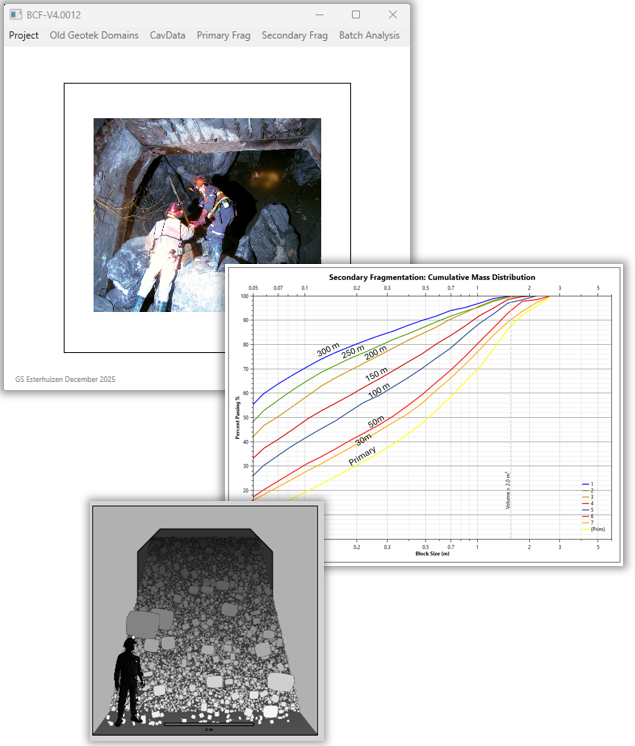
BCFV4 has been developed over a period of more than two years through close collaboration between cave-mining specialists at SRK Consulting in Vancouver Canada and in Santiago Chile, with GS (Essie) Esterhuizen who developed the original BCF software in the early 2000's. The updated BCFV4 makes use of cave fragmentation measurements at operating mines and developments in the understanding of fragmentation processes over the past 20 years to provide improved fragmentation estimates for planned cave mining operations.
BCF is designed so that analyses can be conducted by geologists or geotechnical engineers at a mine site without the need for specialized numerical modeling skills. Analyses can be conducted with limited geotechnical data prior to mining. The analyses are easy to set up and run and provide results in a few seconds, allowing numerous alternatives to be evaluated efficiently.
Fragmentation types
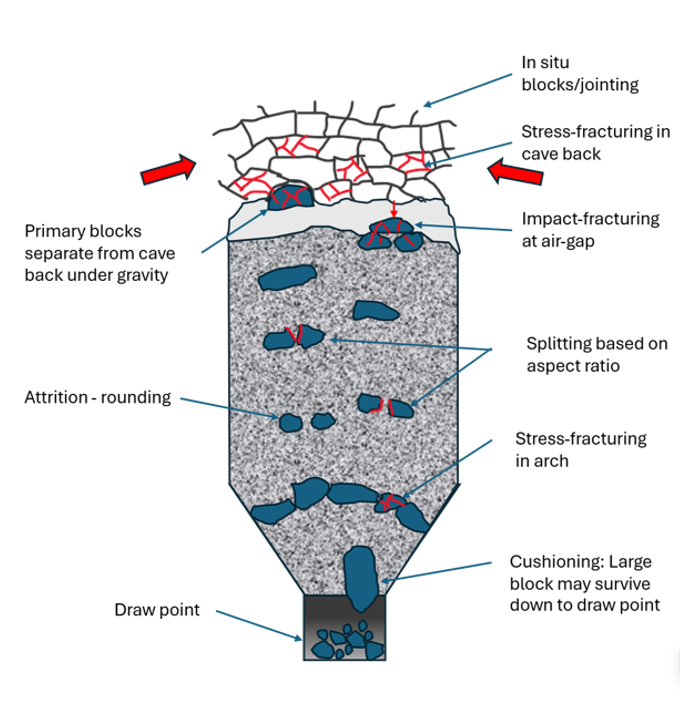
In BCF the rock mass is assumed to be unfragmented prior to mining. Fragmentation of the rock mass occurs when the rock mass separates into blocks that are bounded by fractures such as joints, weak veins or stress fractures. In cave mining the separation of the rock mass into rock blocks is typically driven by gravity or stress fracturing. The following types of blocks are defined:
In situ rock blocks: Blocks that can potentially separate along natural surfaces prior to caving. Actual separation of the rock mass into fragments will depend on stress conditions, shear strength and orientation of fracture planes.
Primary fragments: Rock blocks formed by separation from the rock mass under gravity. This process is called “Primary Fragmentation”
Secondary fragments: Caved rock blocks in the draw column of the cave operation. These rock blocks may reduce in size as they fall onto the top of the draw column, and as they are drawn down to the drawpoints by attrition, splitting, stress fracturing, shearing along internal defects etc. These processes are all part of “Secondary Fragmentation”
BCFV4 remains an empirical fragmentation assessment tool based on observations, insight, rock engineering principles, and engineering judgement. Joint set statistics and rock mass strength parameters are used to create the in-situ block size distribution using topology principles as developed by Goodman & Shi. The calculation methods in BCFV4 have been revamped from earlier versions using the results of recent research, measurements and observations. BCFV4 now produces fragmentation distributions that provide a more satisfactory match to observed block size distributions and the observed fine fraction.
The stress in the cave back determines ultimate primarly fragmentation block sizes through induced shear along joints, clamping of joints, compressive failure of rock blocks, and gravity separation of blocks from the surrounding rock mass.
For secondary fragmentation the height of the draw column as well as the location of a rock block within the draw column determine the driving forces that produce secondary fragmentation. Each primary rock block is traced as it moves down the draw column and either fails in extension under point loads, is crushed by arch formation in the draw column, and is subject to grinding and attrition as block velocities vary within the draw coulmn. In addition, factors such as strength reduction due to weathering can be considered and the contribution of fines materials in providing cushioning to larger blocks is also included. Each time a rock block fails it breaks down into an array of smaller block sizes depending on the driving stress and the potential presence of veins within the rock block.
When a block has travelled through the draw column down to the draw point BCF conducts a rule-based assessment of the likelihood of hangups forming within the drawpoint. The final block size distribution in the drawpoint is calculated and oversize blocks are noted.
BCF Methods
Fragmentation size distributions: The resulting fragment size distributions for both primary and secondary fragments that report at a drawpoint are provided. Analyses can consider the impact of various geotechnical domains, various in-situ stress conditions, and variable heights of draw (HOD) on expected fragmentation. Results are in the form of cumulative size distribution curves that indicate the expected percent oversize blocks, 80% passing size, percent fine materials (less than 5 cm). Estimates are also provided of the number of likely drawpoint hangups per kT.
BCF Results
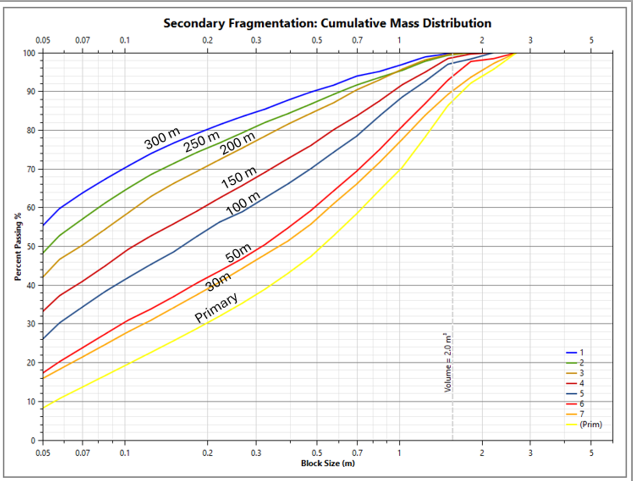
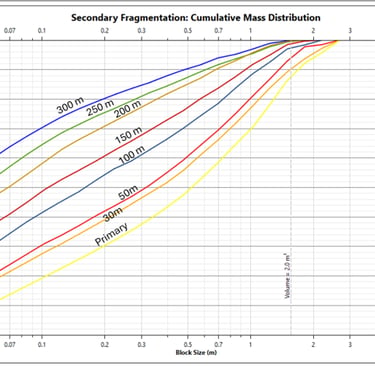
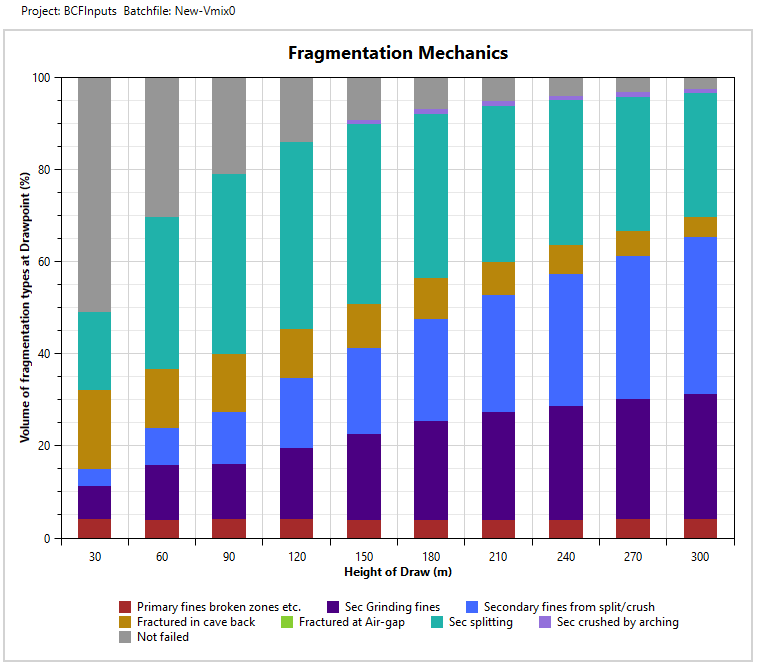
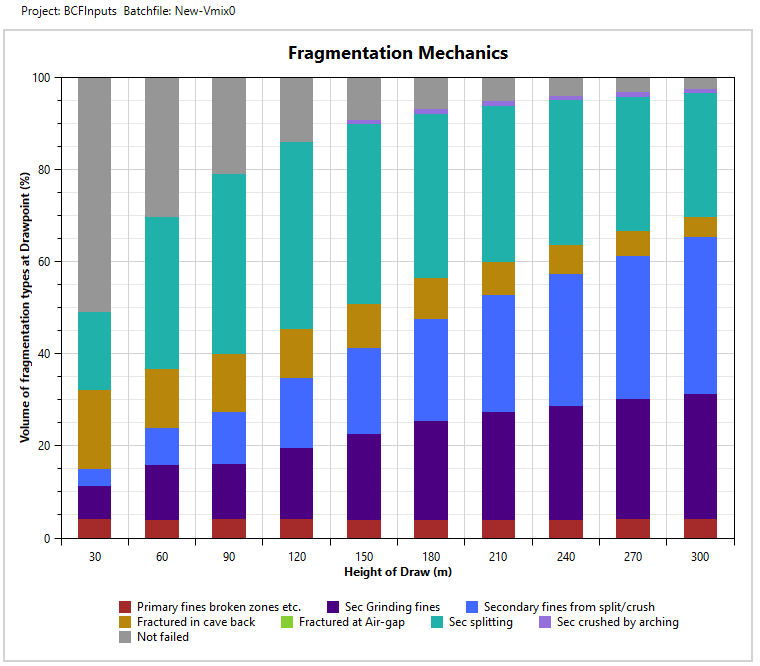
Fragmentation Mechanics: BCFV4 considers several different failure mechanisms that contribute to the final fragmentation distribution that reports at a drawpoint. These include fines generation during stress fracturing in the cave back, dynamic impact of rock blocks when falling through an air gap, block attrition during draw-down in the draw column, splitting of blocks due to point loading, weathering of blocks while in the draw column, the impact of veins withing rock blocks etc. BCFV4 produces a bar-chart that illustrates the contribution of each of these mechanisms to the final fragmentation distribution.
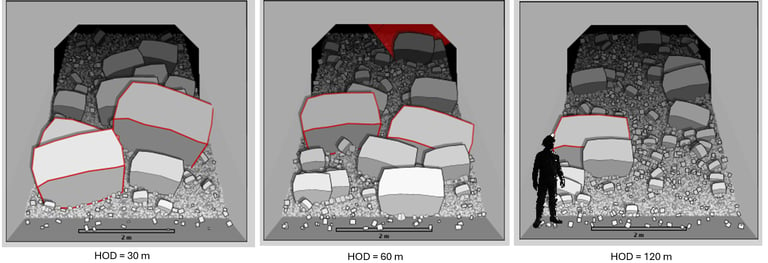
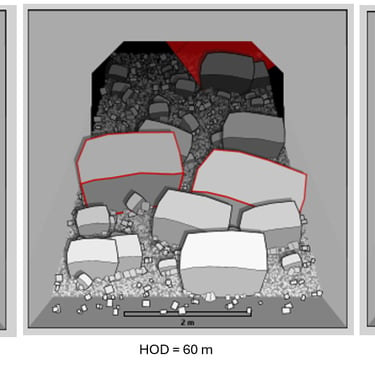
Visualization of fragments in a drawpoint: Using the predicted fragmentation curve, BCFV4 produces visualizations of the rock fragments in a drawpoint. Since one drawpoint cannot be representative of thousands of tons of broken rocks in a geotechnical domain, BCFV4 can repeatedly sample the size distribution curve to create numerous realizations of what a drawpoint is likely to look like for the predicted fragmentation curve.
BCF Results Compared to Mine Measurements
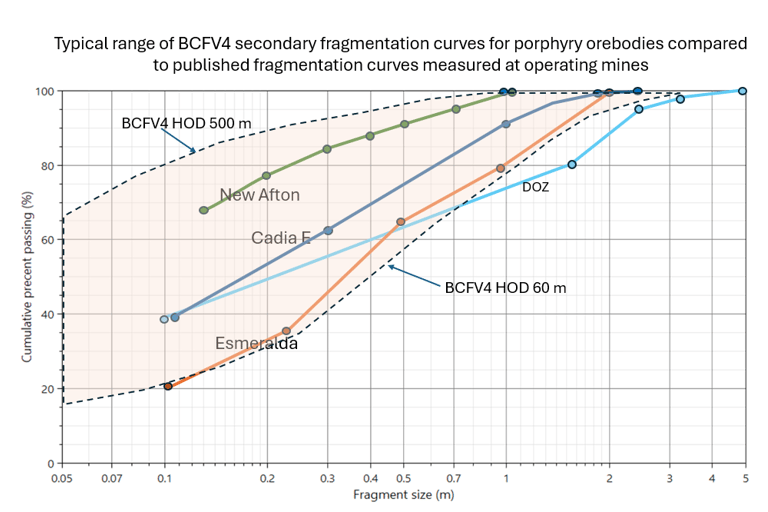
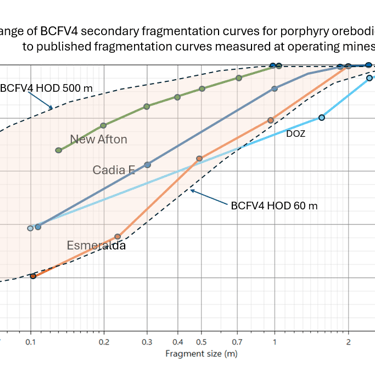
The graph below shows published results of fragmentation measurements at four different block caving mines in variable geotechnical and mining settings. The general trend of BCFV4 produced fragmentation curves for porhyry deposits is superimposed with dashed lines. The BCF curves tend to be s-shaped for lower HOD cases, similar to blast fragmentation curves, but become covex upwards as the height of draw becomes large. This transition of the fragmentation curve from s-shaped to upward curved is observed in measured results also. Addittionally the BCFV4 results predict relatively high percentages of fines materials, similar to the observed ranges of fines.
Try a Demo or Purchase a License
A fully functional demo license is available for BCFV4 which runs for 7 days. Please fill out the form below and request to recieve a free demo license and a link to download BCFV4
Demo:
Purchase:
BCFV4 licenses are available for purchase. A license can be purchased for one, two or multiple simultaneous users. The pricing is as follows in US $:
License type Single user Two users Each additional user
Permanent $8 000 $12 000 $2 000
One year lease $4 000 $6 000 $1 000
Licenses can be hosted on individual user computers or on a company network serving multiple users. BCFV4 does not run on your company server computer, it runs on each individual user's computer. Only the license server runs on the company server requiring miniscule compute. License validity is checked periodically via the internet against license servers in the UK.
If you would like to purchase a BCFV4 license please fill out the form below to request a quote and/or invoice for the purchase. Please state number of licenses required and type (permanent or lease):